I'm writing this blog entry as though Yahweh - the god of the bible - is real. At least in part. I'm doing so in order to point out a ridiculous premise in the faith of Christianity. This blog entry is inspired by a point Matt Dillahunty made on a recent episode of The Atheist Experience.
Christians tell me that their God (Yahweh) wants me to believe in him. He loves me and doesn't want me to burn in hell and to avoid that I need to believe that he is real. Of course if big Y doesn't want me to burn in hell then all he need do is let me into heaven when I die, right?
But apparently that's not part of the deal. Now not all Christians believe this but many will tell me that in order to get into heaven I need to believe in God and I need to believe that Jesus is God's son, he died for my sins and that he's my savior.
Now let's just put all that aside for a moment.
Yahweh has given us a tool that we can use to determine how to tell fact from fantasy. How to tell whether we should accept something or discard it as nonsense It's called 'Reason'. I don't think we're born with it, I think it's something we develop over time and, with the right education, it's something that becomes very valuable to us. We learn reason from those around us - particularly our parents and teachers.
As I said, reason is very important to us. It lets us know there isn't a Nigerian prince waiting to give us a great deal of his fortune. It lets us know that although leaving from the roof is the fastest way to reach the ground from the top of a skyscraper, it's not going to be safe. It's a good tool to use if you need someone's help and they're reluctant or if someone's a bit angry or upset or frustrated and you need them to be calm. I'm sure we've all heard or said 'can't you just reason with them?'.
There are countless other examples of where we need reason to live the lives we do. Without reason society as we know it would cease to exist.
Let's return to Yahweh and his need for us to believe in him to gain entry to heaven (assuming heaven is a place I want to go). The question one must ask is this - why did Yahweh give me such a valuable tool and then make it necessary for me to suspend its use? I can think of no other aspect of my life where suspending reason would be a beneficial thing for me to do. I'm sure I have done it in the past and it's resulted in me being injured, losing money or getting yelled at. Why then would Yahweh make believing in him conditional on me giving up reason and relying on 'faith'?
The simple point is there's no reason to suspend reason. The idea that a god would value faith not just over reason, but as THE most important trait a person can have is ludicrous. The idea that a god appeared to people, instructed them to do things - including wiping out whole towns (except for the female virgins in one case), told a bloke to build a boat and then flooded the entire planet, came to earth as himself/his son and sacrificed himself to himself to make up for the sins HE knew we were going to commit because he created a world in which those sins were possible and then this God would suddenly vanish without a trace (except for the odd appearance on toast and the arses of dogs) and that this 'God' would then expect the rational, clear thinking humans which HE created to suspend reason to believe in him is totally preposterous. It sounds like exactly what it is - a nonsense idea invented by an ancient superstitious people that didn't know better.
What kind of god would give us the gift of reason and then ask us to suspend it so we can believe in him and make it to heaven? My guess is an imaginary one.
Tuesday, 9 April 2013


Sunday, 31 March 2013
Misconceptions about atheism
There is a common trend on twitter for theists to tweet something like 'Atheists believe...' and to then write something about atheists which is just simply not true. This picture gets tweeted quite often:

Of course it's wrong after the second word. Atheism isn't the belief of anything let alone what's described above. I won't go into detail on what's wrong with the above (magically? That's very much the theist position isn't it?) but I will just point out that atheism has NO position on how the universe started, except to say we don't believe a god was responsible. And as I've described here not believing in something doesn't mean you believe the opposite is true. So I'm not going the list each thing about one by one and say atheists don't believe it. The entire thing is incorrect.
Atheism is quite often associated with science and in particular the science of evolutionary biology. Atheism has no position on evolution. It does very much seem to be the case that atheism and evolution go hand in hand. The feeling I have from chatting with fellow atheists on twitter particularly is that the vast majority of atheists accept the fact of evolution. But it's not a 1 for 1 relationship. There are many theists that accept the fact of evolution, including over 10,000 clergy from The Clergy Letter Project. And there are also atheists that do NOT accept evolution. One notable group are the Raëlians. So although there does seem to be a strong correlation between atheists and the acceptance of evolution it is certainly not a case of atheism = evolution = atheism.
The same can be said of Big Bang cosmology. Again experience suggests that atheists accept the Big Bang theory as the best current explanation for the beginning of the universe as we know it. And again it's a position that theists can accept just as easily as atheists. That the universe was started by the Big Bang is not an 'atheist' position it's a scientific position. It's something someone like Professor Lawrence Krauss can explain a lot better than I can (given that I can pretty much not explain it at all that's probably not a big stretch).
Big Bang cosmology and the scientific theory of evolution are not a positions of 'faith' they're not something atheists or anyone else 'believes'. They are the conclusions reached by thorough scientific analyses of available data. People study these fields after years of schooling they then spend years doing research, including, for evolution at least, field work. Their work is reviewed by peers before being published in scientific journals and then being read and, importantly, scrutinized by other experts in that particular branch of science. It's NOT a case of Big Bang or God. It's NOT a case of Evolution or God.
I've mentioned just two areas of science above but you can feel free to insert any other scientific field and the answer is the same - it is not an atheistic position. Atheists are not required to have a position, one way or another, on any of the sciences.
Another common claim about atheists is that we have nothing to live for. As I've said before I'm an atheist - It doesn't mean I have nothing to live for, it means I have nothing to die for. I don't mean that I wouldn't die for my children, for example, I mean there's nothing for me AFTER death, there's no 'great power/lord/being' that I'm going to meet. I don't have any reason to think I'm heading to any kind of paradise or heaven. I don't think there's any virgins waiting for me and I don't think I'll be given my own planet to be god over. So this is what I mean when I say I have nothing to die for. For a longer post on atheists having nothing to live for, you can see my earlier post here.
Atheists hate god - apparently. Hopefully you are already aware of the absolute absurdity here. To highlight it in a question - how can someone hate something in which they don't believe? It's not possible right? As soon as someone thinks there is a god to hate, that someone ceases to be an atheist. We may hate the 'concept' of god. We may hate what the idea of god does to people.We may hate the character 'god' like we do the bad guy in a movie. But hating a god or goddess itself as though there was something to actually hate? No atheist does this.
We atheists also get accused of being Satanists. Now although the Church of Satan is actually atheistic organisation (IE it doesn't have a supernatural deity that it worships) there is, as with the above, no one-to-one relationship between Satanism and atheism. Yes, all the members are atheists but not all atheists are members. The members of the Church of Satan specify that they are not Devil worshipers, a group of people that pray to and revere the Devil - the nemesis of god from biblical and other theistic stories. Estimates put the number of Satanists in the UK at around 3,000. Given that there's nearly 10 million people in the UK with no religion, if you meet an atheist there, the chances of them being a Satanist is pretty slim.
There's no atheists in fox holes, did you know? One of the most common anti-atheism tweet that goes around. When I see someone tweet this I usually reply with a link to the Military Association of Atheists and Freethinkers. Once I do that I get little push back. I had just one person argue that the military atheists were lying and they really did believe. Telling other people what they believe seems to be a common habit among some theists. The point is that not only are there atheists in fox holes (and in turbulent planes and on death beds) the tweet and the sentiment is completely disrespectful. It's again a theist putting their own thinking onto others. They see the world in a particular way and they expect others to agree with them. They also forget that even if their statement is true it doesn't prove a god or goddess exists. And they fail to consider that a decision made under extreme duress (let's face it, if you're taking refuge in a fox hole, it's not because a group of toddlers is watching the Care Bears nearby) is not necessarily going to be the most thought out, most analysed and reasonable decision someone could make. A person who thought their life was in grave danger was desperate enough to consider praying? So what?
On a more philosophical level atheism gets called a world view. We get asked, as atheists, what our goal is, where we think society should head, and if we're so determined to get rid of god and faith, what are we going to replace it with. These are all fine questions to have but they are misplaced when being asked to an atheist because of atheism. Atheism is not a world view. Atheism doesn't guide how we think, it's a result of how we think. Although we do look at the world through an atheist's eyes there needs to be something on top of it to qualify as a world view as repeatedly stated, atheism is a single response to a single question. Similarly it's not an ideology, we're not here saying 'be atheists and live like this...'. Our ideologies differ. Personally I'm a big fan of what Martin Pribble wrote about Methodological Humanism. I can't help but think if the world embraced this idea everyone would be a lot better off, but that is of course one opinion among many.
It may be a fault of a failing of atheism or atheists that we aren't organised, that we don't have common views outside of not believing in a god. It's a blog for another time but I do wonder sometimes about atheism becoming more of a societal movement and whether that would help or hinder. My first question to myself is always - Would it be exclusionary? But as above, that's a blog for another time.
We atheists get told we're hated, that we're going to burn in hell and yesterday I saw a tweet that read 'No offence, but if you're an atheist, you're disgusting'. You guessed it, from a Christian. I couldn't tell you why they think of us like this. When I was a Christian I never hated anyone - why so much hatred for us? If there was a one-to-one relationship between atheists and people that kick puppies, then maybe you could understand a certain level of dislike. But we're atheists, we're not animal kickers. I think it stems from misinformation and lack of understanding. People fear what they don't understand and fear leads to hate.
One of the things I like to do on twitter is help educate people on what atheism really is and what atheists are really like. Hopefully the above can put some of the more common misconceptions to bed.
Wednesday, 13 March 2013
Why "Look Around You" is not proof of god.
An argument I hear often for apparent proof of god is to 'look around you' and is often followed by something like 'how could all this get here?' or 'where did we come from?'.
The point being that because we don't have full explanations for everything a god must be responsible. It is, of course, an argument from Personal Incredulity or an argument from ignorance.
Of course this type of thinking has failed time and time again. In his short film 'Storm' Tim Minchin makes the point....

We can replace 'magic' with 'god' and it's still true and I feel it's important to note. There has been countless phenomena throughout time that started as a mystery but is now explained and not once - repeat NOT ONCE has that explanation turned out to be god.
What we do have is a bunch of former mysteries that were attributed to gods that we now know are definitely not the direct result of gods. For example live in Greece a few millennia ago and you'd be thinking that lightning was the work of Zeus throwing it from Mount Olympus or his horse Pegasus bringing it across the sky. Others have thought thunder was the work of Thor or that an eclipse was a heavenly dog taking a bite out of the sun. We now know these explanations and dozens more like them are not valid. What we have now are natural, understandable, and - perhaps most importantly - verifiable explanations.
We have moved past the 'I don't know, therefore god' phase of our existence. Since the development of the scientific method we now investigate until we find the answer. We make conclusions on what is observed and what is demonstrable. We don't, and nor should we, find it acceptable to say 'I can't find the answer to this mystery, therefore a god must be responsible'. To do that is completely intellectually unsatisfying.
I cannot blame someone without modern investigative tools for not knowing what caused lightning. I can understand a primitive person thinking the sun was a god or that it literally traveled across the sky or even that it was something to be appeased with a sacrifice. These are the kinds of things I would expect people of long ago to think. Remember that not only did these people not know how certain things worked, they didn't know *how* to know. They observed and assumed with no investigation.
Today though, things are very different. It's not good enough for a person to think a planet was just 'put' here. Thanks to our scientist friends and many, many decades of investigation we know how planets form and a god putting them there is not it. Mix cosmic dust, gravity, and a WHOLE lot of time and you'll get yourself a planet. Or a star for that matter.
We also know that the circumstellar habitable zone (CHZ) or 'Goldilocks zone' is not narrow. We know that it's not a case of '10 ft closer and we'd burn, 10 ft further away and we'd freeze' as I've seen written as a Facebook status. This passage from bible.org on an 'evidence for God's existence' article is quite misleading and I suspect deliberately non-specific...

The CHZ is measured in Astronomical Units. An astronomical unit is the mean distance from Earth to the sun. One Astronomical unit is 149,597,871 Kilometres (92,955,807 Miles).
The CHZ ranges from approximately .725 astronomical units (108,458,455.75 kms) to 3 astronomical units (448,793,613 kms).
So when the above passage says 'If we were closer to the sun we'd burn up' it's saying that for the Earth cease supporting life it would need to be closer than .725 astronomical units. What they're not saying is Earth could move 41,139,415 kms closer to the sun and would *still* be capable of supporting life. Similarly, when the above says 'If we were farther away we'd freeze' it means is that Earth would need to be more than 3.0 astronomical units away from the sun. This means the Earth could move a not insignificant 299,195,742 kms further away from the sun and *still* be capable of supporting life.
In essence the passage in the screen shot above *is* accurate. However, they fail to tell you that the 'closer' and 'farther away' they speak of is actually a zone something around 340,335,157 kilometres (211,474,461 miles) wide. I bring this up not to highlight the misleading information in the screenshot but to show that the assumption that we are here because Earth is 'perfectly placed' is simply wrong. It is another example where lack of information was covered over with 'God did it' but further investigation showed that it wasn't quite the work of a god as first thought.
This is the bottom line problem with the 'Look around you' argument. When I look around me everything I see (with NO exception) has either a verifiable NATURAL explanation or NO verifiable explanation as yet (note - Yet). The only time the god hypothesis is invoked is when a person (who already believes there is a god - it is never a conclusion reached from an unbiased investigation) cannot otherwise explain what they see. They cannot explain life - therefore god. They, of course, ignore all the work going on in the field of Abiogenesis. They cannot explain diversity of life - therefore god. They do this usually having heard of evolution but not really understanding what it is (if we evolved from monkeys, why are there still monkeys!). I have had a person on twitter thank me for sending them links to evolution web sites and telling me that they didn't believe it previously because they had the wrong idea about it.
It's not just events on a grand scale either. Take a disease such as epilepsy. Imagine living 2000 years ago and having no idea what epilepsy was, having no idea about medical science, but believing in the supernatural. If you were to witness a person having a seizure would you think anything other than some kind of supernatural event was happening? Possession by demons? Some kind of spirit trying to enter the physical realm? These kinds of assumptions at that time, with limited information, would be understandable. But as is always the case, proper investigation shows once again that this is NOT a case of god did it.
'Look around you' is lazy. It's intellectually inept. It's not just an admission that you don't have a verifiable answer, it's an admission that you can't be bothered searching for one. It's plugging a gap in knowledge with a phrase that answers and explains nothing.
Thunder, lightning, mountains, orbits, diversity of life, ears, eyes, thumbs, eclipses, disease, spring, summer, autumn, winter, the moon, the sun, Earth - the god hypothesis fails time and time again. Given that the god hypothesis has never been the verified explanation for anything in the past, why make the assumption that it will be the verified explanation for anything in the future? Surely the logical and intellectually honest thing to do is to reserve judgement, investigate, follow the evidence, see where it leads THEN make a conclusion.
So in summary, two points:
With this in mind, how exactly is 'look around you' proof of god? Simply, it is not.
The point being that because we don't have full explanations for everything a god must be responsible. It is, of course, an argument from Personal Incredulity or an argument from ignorance.
Of course this type of thinking has failed time and time again. In his short film 'Storm' Tim Minchin makes the point....
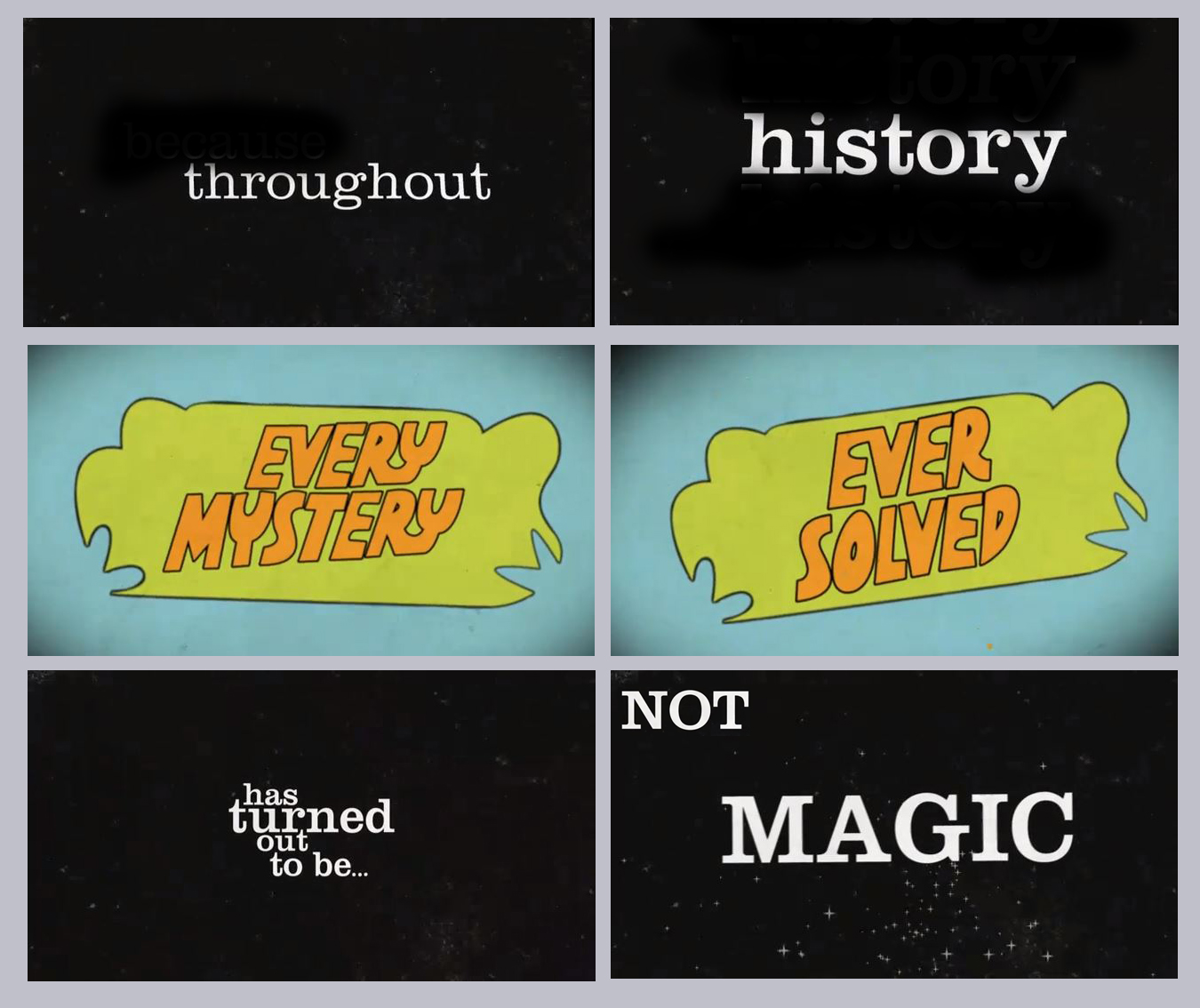
We can replace 'magic' with 'god' and it's still true and I feel it's important to note. There has been countless phenomena throughout time that started as a mystery but is now explained and not once - repeat NOT ONCE has that explanation turned out to be god.
What we do have is a bunch of former mysteries that were attributed to gods that we now know are definitely not the direct result of gods. For example live in Greece a few millennia ago and you'd be thinking that lightning was the work of Zeus throwing it from Mount Olympus or his horse Pegasus bringing it across the sky. Others have thought thunder was the work of Thor or that an eclipse was a heavenly dog taking a bite out of the sun. We now know these explanations and dozens more like them are not valid. What we have now are natural, understandable, and - perhaps most importantly - verifiable explanations.
We have moved past the 'I don't know, therefore god' phase of our existence. Since the development of the scientific method we now investigate until we find the answer. We make conclusions on what is observed and what is demonstrable. We don't, and nor should we, find it acceptable to say 'I can't find the answer to this mystery, therefore a god must be responsible'. To do that is completely intellectually unsatisfying.
I cannot blame someone without modern investigative tools for not knowing what caused lightning. I can understand a primitive person thinking the sun was a god or that it literally traveled across the sky or even that it was something to be appeased with a sacrifice. These are the kinds of things I would expect people of long ago to think. Remember that not only did these people not know how certain things worked, they didn't know *how* to know. They observed and assumed with no investigation.
Today though, things are very different. It's not good enough for a person to think a planet was just 'put' here. Thanks to our scientist friends and many, many decades of investigation we know how planets form and a god putting them there is not it. Mix cosmic dust, gravity, and a WHOLE lot of time and you'll get yourself a planet. Or a star for that matter.
We also know that the circumstellar habitable zone (CHZ) or 'Goldilocks zone' is not narrow. We know that it's not a case of '10 ft closer and we'd burn, 10 ft further away and we'd freeze' as I've seen written as a Facebook status. This passage from bible.org on an 'evidence for God's existence' article is quite misleading and I suspect deliberately non-specific...

The CHZ is measured in Astronomical Units. An astronomical unit is the mean distance from Earth to the sun. One Astronomical unit is 149,597,871 Kilometres (92,955,807 Miles).
The CHZ ranges from approximately .725 astronomical units (108,458,455.75 kms) to 3 astronomical units (448,793,613 kms).
So when the above passage says 'If we were closer to the sun we'd burn up' it's saying that for the Earth cease supporting life it would need to be closer than .725 astronomical units. What they're not saying is Earth could move 41,139,415 kms closer to the sun and would *still* be capable of supporting life. Similarly, when the above says 'If we were farther away we'd freeze' it means is that Earth would need to be more than 3.0 astronomical units away from the sun. This means the Earth could move a not insignificant 299,195,742 kms further away from the sun and *still* be capable of supporting life.
In essence the passage in the screen shot above *is* accurate. However, they fail to tell you that the 'closer' and 'farther away' they speak of is actually a zone something around 340,335,157 kilometres (211,474,461 miles) wide. I bring this up not to highlight the misleading information in the screenshot but to show that the assumption that we are here because Earth is 'perfectly placed' is simply wrong. It is another example where lack of information was covered over with 'God did it' but further investigation showed that it wasn't quite the work of a god as first thought.
This is the bottom line problem with the 'Look around you' argument. When I look around me everything I see (with NO exception) has either a verifiable NATURAL explanation or NO verifiable explanation as yet (note - Yet). The only time the god hypothesis is invoked is when a person (who already believes there is a god - it is never a conclusion reached from an unbiased investigation) cannot otherwise explain what they see. They cannot explain life - therefore god. They, of course, ignore all the work going on in the field of Abiogenesis. They cannot explain diversity of life - therefore god. They do this usually having heard of evolution but not really understanding what it is (if we evolved from monkeys, why are there still monkeys!). I have had a person on twitter thank me for sending them links to evolution web sites and telling me that they didn't believe it previously because they had the wrong idea about it.
It's not just events on a grand scale either. Take a disease such as epilepsy. Imagine living 2000 years ago and having no idea what epilepsy was, having no idea about medical science, but believing in the supernatural. If you were to witness a person having a seizure would you think anything other than some kind of supernatural event was happening? Possession by demons? Some kind of spirit trying to enter the physical realm? These kinds of assumptions at that time, with limited information, would be understandable. But as is always the case, proper investigation shows once again that this is NOT a case of god did it.
'Look around you' is lazy. It's intellectually inept. It's not just an admission that you don't have a verifiable answer, it's an admission that you can't be bothered searching for one. It's plugging a gap in knowledge with a phrase that answers and explains nothing.
Thunder, lightning, mountains, orbits, diversity of life, ears, eyes, thumbs, eclipses, disease, spring, summer, autumn, winter, the moon, the sun, Earth - the god hypothesis fails time and time again. Given that the god hypothesis has never been the verified explanation for anything in the past, why make the assumption that it will be the verified explanation for anything in the future? Surely the logical and intellectually honest thing to do is to reserve judgement, investigate, follow the evidence, see where it leads THEN make a conclusion.
So in summary, two points:
- Everything I see has either a verified NATURAL explanation or no verified explanation as yet.
- God has consistently failed as an explanation in the past, why make the assumption that a god will be the verified explanation for anything in the future?
With this in mind, how exactly is 'look around you' proof of god? Simply, it is not.
Sunday, 10 February 2013
Vocal atheism - It might not be what you think it is...
"Vocal atheism". I think this is what people mean when they say 'Militant atheism' or 'Fundamental atheism'.
I guess I am what would be considered a 'vocal' atheist, especially online because of this blog and my twitter account. It's a label I'm happy to wear, but I wish I didn't need it You see what many people (theists, people that would call themselves agnostic, and even other atheists), don't seem to understand is that being a vocal atheist is a *defensive* position. They don't realise that the vocal atheist comes about because of the intrusion of religious thinking, religious rules, and religious opinions into the lives of those that don't share the religious belief.
For example - if a religion believes that their god doesn't want same-sex couples to marry then there is a question as to whether or not their church is right to not perform the ceremony. However, that religion does *not* have the right to force their position onto all society. Religion doesn't own marriage therefore religion doesn't get to decide who can get married and who can't.
The issue is that religions and religious groups try to force their beliefs onto society anyway. In Australia we've got the Australian Christian Lobby which is very outspoken in its opposition to same-sex marriage.
THAT is the kind of thing that vocal atheists are against, that is why atheists feel the need to speak up. When vocal atheists speak out, we're speaking out AGAINST something. We're speaking out AGAINST the intolerance of religion, AGAINST the ignorance of religion and we speak out against the use of ancient superstition to justify these things.
When actions are guided by unjustifiable beliefs (theism), the actions themselves are also unjustifiable. Vocal atheists speak out against religion and argue against religious people because theism IS based on unjustifiable beliefs. When a theist makes a case against something such as same-sex marriage because their 'god says homosexuality is a sin' they have NO valid reason for this position. No theist can prove their god exists therefore no theist can prove that any god is against same-sex marriage. They cannot prove that their holy book is the word of a god so any argument against same-sex marriage based on the content of their holy book is instantly dismissable.
THIS is what vocal atheism is - standing against the intolerance, ignorance, and oppression of religion. It's standing against the idea that ancient mythology should be taught along side actual scientific theory as a *genuine* alternative. It's standing against the idea that a same-sex couple can't get married because some unproven god doesn't like it. It's standing against the idea that woman are second class citizens, that wives should be beaten because some ancient holy book says it's ok.
What we're not against is the right for people to believe what they want. If Auntie Doris wants to visit her church every Sunday and hang with her friends and talk about how good they think this Jesus guy is...good luck to her. If Khaled wants to head to the mosque and worship Allah and think that Allah is all kinds of awesome - good luck to him. As long as this is kept to themselves, there's no problem. But when Auntie Doris says 'Gods says..... and therefore you can't....' that's when we have a problem. Believe what you like, just don't use that belief to negatively impact on the lives of others.
Also, we're not about forcing atheism onto people. We're not about standing on street corners and spreading 'the word' of atheism. Don't want to talk about atheism? Don't bring up religion, don't bring up atheism and I'm sure you'll be fine. If atheists shut up, we'll still hear from theists. If theists shut up, they'll stop hearing from atheists.
Vocal atheists exist because religion does NOT have free reign over society. Religion does not have the right to tell people how they can and cannot live, what is acceptable and what is not. There are millions of people on earth who have no religious belief and we should have the right to live free from the imposition of religion into our lives.We are not religious so religion should have no impact on us whatsoever.
Vocal atheists exist because not all people are religious and religious people need to know this.
Monday, 29 October 2012
Why I celebrate Christmas
I often see on twitter Christians getting in a huff about atheists celebrating Christmas. They seem to be quite upset about people who don't see Jesus as the son of the bible God, Yahweh, joining them in an event that, they believe, is the celebration of his birth.
Followers of my blog and my twitter account will know that I grew up in a Christian family and was indeed a Christian myself for many years. Christmas was a huge event. When I was quite young we'd head to my grandparent's house after we'd done our thing at home. We'd usually head back there on Boxing Day to help take care of all the food that had been left over from the day before.
When my grandmother died my grandfather moved away to a place down near the beach. We'd take a drive down there, stay over night, and come back home late Boxing Day. It was a huge event because it's a massive family. My grandfather, his 10 kids, their partners and children. Then some of the grandchildren (my generation) got our own partners. We're easily talking 40+ people. It was a wonderful time. After my grandfather died the 10 'kids' as we still think of them took it upon themselves to take turns in hosting, though it was now on only boxing day. It's still a big event. Some of my dad's brothers and sisters are now grandparents themselves. Many of my cousins have partners and children of their own. Not everyone can get there each year but it's still a large group of people to have all together in the one place, especially considering we're all essentially the same family.
Of course that's not the only Christmas thing I do, just the biggest. There's also work functions, gatherings with friends, getting together with my mum's side of the family and my partner's family. I will attend 8 to 10 Christmas functions or gatherings a year.
What's interesting is that Jesus Christ is never mentioned. Not once. Not even by the Catholics. Putting aside for the moment that the origins of Christmas can be traced to pre-Christ days, and that if Jesus did exist, he probably wasn't born on December 25th, Christmas has long been removed from the celebration of Christ's birth and has since become a celebration in its own right. A celebration for the sake of celebrating.
Don't get me wrong, I'm not saying there's no one left that celebrates Christmas as the birth of Christ, I'm saying that in my experience it's not the focus of people I know.
When we talk about Christmas, it's never about the birth of Jesus, it's about shopping for presents (for family, friends, workmates, and things like The Wishing Tree), it's about getting together and 'catching up', it's about parties, and functions, and drinking and eating, and simply wanting to have fun with those whose company we enjoy.
Christmas was a massive part of my life growing up, and it's still a huge part of my life now. That's why I celebrate it, because it means so much to me. It's not because of someone that biblical expert Francesca Stavrakopoulou describes at best as 'probably' existed (fellow biblical expert Richard Carrier now argues that Jesus in fact never existed). I don't celebrate Christmas because of the Winter Solstice (I'm in the southern hemisphere, it's not the winter solstice for us anyway). I celebrate Christmas because it's FUN. It brings me joy and brings joy to my family, friends, and colleagues.
I celebrate Christmas for the sake of it. Yes, the name is a hangover from Christian influence (I've light-heartedly taken to calling it Giftmas), and yes, there is still a great deal of Christians that think they're celebrating the birth of their Savior. Anyone that wants to celebrate it that way can continue to do so. Nothing about how I celebrate Christmas is going to stop any Christian celebrating it they way they want to.
I love this time of year and getting together with so many people and I assume, and hope, that they like getting together with me too. It's a wonderful time where we can look back at the year we've just had and relive the highlights, and commiserate the low lights. We can look forward and share with our family and friends our hopes, dreams, and expectations for the year to come and we can do it over good food and good drinks. It's a time of year where we can get together with all the people we know and love just because we want to, because we think it's a good idea and we like it. It doesn't require the alleged birth of an alleged messiah.
The thing is, not only do Christians not own late December celebrations, they didn't even invent them.
Followers of my blog and my twitter account will know that I grew up in a Christian family and was indeed a Christian myself for many years. Christmas was a huge event. When I was quite young we'd head to my grandparent's house after we'd done our thing at home. We'd usually head back there on Boxing Day to help take care of all the food that had been left over from the day before.
When my grandmother died my grandfather moved away to a place down near the beach. We'd take a drive down there, stay over night, and come back home late Boxing Day. It was a huge event because it's a massive family. My grandfather, his 10 kids, their partners and children. Then some of the grandchildren (my generation) got our own partners. We're easily talking 40+ people. It was a wonderful time. After my grandfather died the 10 'kids' as we still think of them took it upon themselves to take turns in hosting, though it was now on only boxing day. It's still a big event. Some of my dad's brothers and sisters are now grandparents themselves. Many of my cousins have partners and children of their own. Not everyone can get there each year but it's still a large group of people to have all together in the one place, especially considering we're all essentially the same family.
Of course that's not the only Christmas thing I do, just the biggest. There's also work functions, gatherings with friends, getting together with my mum's side of the family and my partner's family. I will attend 8 to 10 Christmas functions or gatherings a year.
What's interesting is that Jesus Christ is never mentioned. Not once. Not even by the Catholics. Putting aside for the moment that the origins of Christmas can be traced to pre-Christ days, and that if Jesus did exist, he probably wasn't born on December 25th, Christmas has long been removed from the celebration of Christ's birth and has since become a celebration in its own right. A celebration for the sake of celebrating.
Don't get me wrong, I'm not saying there's no one left that celebrates Christmas as the birth of Christ, I'm saying that in my experience it's not the focus of people I know.
When we talk about Christmas, it's never about the birth of Jesus, it's about shopping for presents (for family, friends, workmates, and things like The Wishing Tree), it's about getting together and 'catching up', it's about parties, and functions, and drinking and eating, and simply wanting to have fun with those whose company we enjoy.
Christmas was a massive part of my life growing up, and it's still a huge part of my life now. That's why I celebrate it, because it means so much to me. It's not because of someone that biblical expert Francesca Stavrakopoulou describes at best as 'probably' existed (fellow biblical expert Richard Carrier now argues that Jesus in fact never existed). I don't celebrate Christmas because of the Winter Solstice (I'm in the southern hemisphere, it's not the winter solstice for us anyway). I celebrate Christmas because it's FUN. It brings me joy and brings joy to my family, friends, and colleagues.
I celebrate Christmas for the sake of it. Yes, the name is a hangover from Christian influence (I've light-heartedly taken to calling it Giftmas), and yes, there is still a great deal of Christians that think they're celebrating the birth of their Savior. Anyone that wants to celebrate it that way can continue to do so. Nothing about how I celebrate Christmas is going to stop any Christian celebrating it they way they want to.
I love this time of year and getting together with so many people and I assume, and hope, that they like getting together with me too. It's a wonderful time where we can look back at the year we've just had and relive the highlights, and commiserate the low lights. We can look forward and share with our family and friends our hopes, dreams, and expectations for the year to come and we can do it over good food and good drinks. It's a time of year where we can get together with all the people we know and love just because we want to, because we think it's a good idea and we like it. It doesn't require the alleged birth of an alleged messiah.
The thing is, not only do Christians not own late December celebrations, they didn't even invent them.
Monday, 24 September 2012
Being an atheist when my dad died.
I wrote this several months ago but have decided to put it up as a blog post because someone asked me what it was like, as an atheist, to deal with the death of someone close. When I wrote this piece I linked a lot of what I thought and how I dealt with it to being an atheist. I think that's not quite right now. I have come to think that atheism is the result, not the cause, of who I am and how I think. So below where I say something like 'as an atheist' read something like 'what it is about me that makes me an atheist...' I hope you understand what I mean :)
------------------------------------
Dad first told me he had cancer two years ago. Oesophageal cancer right at the bottom of his throat. He went through a massive operation where the majority of his Oesophagus was removed and his stomach was basically attached to the bottom of his throat. He also had a lot of chemotherapy and radiation. It was declared a success. After days in intensive care and a long recovery period he returned to what for him was a normal life. He would occasionally have to go and have his throat expanded so he could eat freely, but that was it...for a while.
With almost a feel of inevitability, dad called me one day and said that the cancer had returned. After living one year cancer free after the operation the disease was back and he was literally in the battle of and for his life. He battled hard and long but in the end, as it so often does, the cancer won, and on December 17th 2011 my dad died. I was at the hospital, but outside the room when it happened. I was on the phone to my children's mum discussing when – if at all – to bring them in to see dad. My eldest daughter was playing tennis. Normally I would have been there watching, but not this day. They came, but were about 30 minutes too late. I told them the news outside the hospital and they all broke down. I tried to comfort my children as best I could while still dealing with the grief that had kicked me only minutes before. Anything I could say about what I felt at that moment would be a dismal understatement.
I received a call quite early that morning from dad’s wife. I was planning on going in to the hospital later that morning, after the aforementioned tennis, but overnight dad had taken a turn and if I wanted to see him, I didn't have much time. I got dressed quickly and headed to the hospital. When I arrived I saw one of dad’s 4 sisters outside the room. Inside were Sonja – dad’s wife, another of dad's sisters, and Mick, who had been dad’s best mate for nearly 40 years. Dad’s sisters were crying, Sonja was strong and Mick was silent. We spent time with dad, but he wasn't conscious. His breathing looked extremely painful and difficult. He had an oxygen mask on, but no other medical equipment. We talked to each other about dad, and to him on occasion. We even laughed. If someone had told me I'd be laughing whilst I sad beside my dad as he died I'd have thought them crazy. But that would have been because I didn't understand. I understand now.
After a little while I wondered what to expect. All I knew at that stage was that dad was extremely unwell.
I went out to the nurses’ station, explained who I was and asked simply ‘Just wondering what happens from here’. The nurse explained that over a period of time – and she couldn't say for sure how long, but certainly 'hours' – dad’s breathing would start to change. His breathing would become more moist and we’d be able to hear that, then it would become irregular – a few short breaths followed by a pause, then maybe a deep one, then a few short ones again. I remember her saying ‘That will continue until the end’. She expected that to be sometime that afternoon, but like I said, she couldn't say for certain. I thanked her for her explanation and went back to the room.
I sat and thought about the way she spoke to me. I loved it. It was factual and to the point, whilst still dealing with me with compassion and empathy. I have said both on twitter and Facebook that good morals come from Empathy, Compassion, and Logic. The nurse’s compassion and empathy were noticeable, but she didn't hide the truth. There would have been no benefit to lying to me – to trying to say that there was a chance of a ‘miracle’ recovery. I didn't want false hope, I wanted the truth and that’s what I received.
Obviously it was an important moment for me because out of a very difficult day, it’s still very clear in my mind. I don’t know the nurse’s particular beliefs, but I was very glad she didn't say something to me like ‘He’ll soon be in heaven’. I would have had a real issue with that. I think being an atheist has grown my appreciation for the ‘facts’ and that’s exactly what the nurse provided. The nurse had it spot on as far as dad’s breathing went. I remember hearing his breathing get moist, I remember noticing the change in the timing of his breaths and in my head I thanked the nurse again for what she had told me. I've had someone ask if I prayed during this time, suggesting that maybe at a time like this why not try anything? I didn't pray once. Didn't even think about it. I sat holding my dad's hand while he was in the last hour of his life and the thought of praying for him never occurred to me.
As is quite common with anyone with a terminal illness, despite knowing what’s coming, the moment it happens, or the moment you find out, is still a shock and still incredibly heartbreaking and simply – sad. I was walking back to the room after my phone call and one of dad’s brothers (three of his five had arrived in the mean time) said to me ‘They said it might be soon Don, you might want to head in there’. I entered the room and could see right away that dad was no longer alive. There was two nurses in there tending to him and Sonja was sitting by his side. The nurses had removed the oxygen mask and the room smelled different. Sonia told me he had gone.
I was totally flat. Numb. There’s nothing I could say to describe the feeling that would convey what I felt. Only clichés come to mind and they fall terribly short. I went over, kissed him, held his hand and told him I loved him. Sonja said someone needed to let his brothers know, so I walked out, looked up, and saw 3 of my uncles, two of their wives, and two of my cousins standing just outside the door. ‘He’s gone’ I said and cried and cried. One of my uncles came and gave me a big hug. Another came and put his hand on my shoulder. I’m a 38 year old man with children of my own, but was so thankful to have a ‘grown up’ there to comfort me at that moment.
On twitter I often see the comment ‘The awkward moment when an atheist is thankful but has no one to thank’. I know it’s a somewhat facetious comment, but I think the sentiment is genuine – with no belief in god, who do atheists thank when something good happens? I always respond the same way – We thank our family and friends, you know – actual people that actually helped us.
At the moment, probably the worst moment of my life – it was my family that helped me. It was my family that wrapped their arms around me and comforted me with their touch. I was extremely grateful they were there. Actually there. Not in my mind, not looking down from heaven – real people, really there with me. Really there to help. I didn’t need, nor, thinking back, would have wanted, some unknown, unknowable ‘being’ imposing on that moment. I felt loved and cared for and it was family that made me feel that way. Real people. I invited them to come in, if they wished, to say there final farewells, which they all did.
Like I said earlier, I spoke to dad after he’d died. Not because I think he could hear me - because I don’t. I’m not really sure why I did it but if I had to guess, it would be in order to have a final moment. It was, I guess, so I could say good-bye to him, not so he could hear good-bye from me.
The rest off that day felt very strange and it’s hard to describe how I felt without again reverting to using of some kind of cliché. But I guess clichés come about because they’re accurate, at least some of the time. So let me say I felt like I was in a void. It was empty. Loss. Anyone that has gone through the death of a close loved one would know the feeling, I’m sure. My dad was gone and was never coming back. I’d never hear his voice again, I’d never see him again, I’d never hug him again, I’d never share a beer with him again. I was terribly sad. I didn’t think he was in heaven, he was simply gone. As atheists we often talk about making the most of this life, and how precious THIS life is, because we don’t believe in an ‘after life’. I feel my dad lived a good, if simple life. His feelings on the subject of an afterlife were different to mine, and I guess if he was right and I am wrong he knows. If I am right and he was wrong, he’ll never know. I hope he did appreciate the life he had and realised it was precious.
I spoke at his funeral and when I stood at the dais in the church (it was a religious service – catholic in fact) I looked up and saw what I would guess was around 300 people. I was moved. To look up and see that so many people cared enough for him to come along to his funeral was all the proof I needed that he had lived a good life. He was just a regular bloke but he’d obviously touched a lot of lives in the 61 and a bit years he had here. So as an atheist I’m proud of that. I can look at the life my dad lived and know that on the balance of things, he will be remembered as a good bloke. Did he mess up? You bet. Was he perfect? Of course not. But can any one of us claim we are? No.
Clearly I don’t think I’ll ever see my dad again and this is where I think being an atheist helps me again. Because I celebrate him and his life. I don’t need to have a thought of meeting him again in the afterlife, I’m thankful and happy for the life I had with him. It’s the time I got to spend with him that I think about, not the strange hope that he might be waiting for me when I die.
Atheism is natural for me, it’s the only position that makes sense. I understand what it’s like to be a Christian, I was one for a couple of decades, but looking back, I just don’t get it. I don’t want to be a person that’s happy to believe in things without evidence. I like understanding how things actually work. But that doesn't mean I’m without emotion. It doesn’t mean that when my dad died I was devoid of feelings and simply said ‘ok, time to move on’. I was terribly sad, and I still cry now when I think about him. But I understand what happened and I understand that my dad’s life is over. His existence is remembered by his family and friends, but he himself is gone and even though it makes me sad, I’m ok with knowing that’s how it is. I don’t like that my dad is dead, but I like knowing that he had a life – a good life –and that I was lucky enough to be not only part of it, but a result of it.
I think being an atheist makes me strong, but not emotionless. I think being an atheist make me appreciative of the facts, without being cold. I think being an atheist lets me love the life I have and helps me understand that I get one chance at it.
Wednesday, 12 September 2012
Marriage equality.
It is expected that next week the Australian senate will vote on the issue of marriage equality. At this stage it looks like the 'for' side is about 8 votes short of victory with 16 senators either undecided or with their view unpublicised.
I took the time to write to each of the undecided senators from my home state and wanted to share the email here:
Dear Senator .
Australia is a nation that prides itself on giving people a fair go. We want to be known as a country that is for equal opportunity and against discrimination.
I ask you to please take the time to read some points below, and with this in mind I urge to to vote in favour of marriage equality in the upcoming senate vote.
There is no valid reason to keep couples of the same sex from marrying. Marriage is not owned by religion, therefore religion shouldn't be a factor. No one is asking any religion to perform a marriage that they feel goes against their teachings. Atheists are allowed to marry, clearly showing that marriage in Australia is irreligious.
Marriage is not for the purpose of having children. We don't tell couples that can't, or don't want to have children, that they can't marry. We don't tell married couples that find out they can't have children that they must get divorced. To say that same-sex couples shouldn't marry because they can't have children is therefore a flawed argument.
Marriage equality is not a pathway to people marrying siblings, pets, or furniture. This is a slippery slope fallacy and is an invalid objection. The marriage equality debate is about allowing people in same-sex couples the right to marry each other. That is all.
Given the above, I hope you understand that marriage is a way for two people to commit their lives to each other. It is for two people to make a bond with the partner of their choice, regardless of religion, or the desire for procreation. The commitment of marriage is not diminished if these people happen to be two women or two men, but our nation is less fair if we prohibit these marriages.
The Australian public supports marriage equality because the majority of people understand that a law that keeps same-sex couples from marrying whilst giving the privilege to opposite sex couples is discriminatory and hurtful and such laws have no place in a modern and fair Australian society.
The world is moving forward and marriage equality is becoming the norm in more and more places. Common sense dictates that in a progressive and fair nation like our own, marriage equality is inevitable. The question is - are you going to be among the first to support it, or among the last to oppose it?
Regards,
Helping a new atheist
Back in the early days of my twitter account I gained a follower that was new to/on the verge of atheism, though I didn't know this detail at the time.
I have her permission to write this blog but she'd like to remain anonymous so I'll call her Amy. If by some chance you happen to recognise who it is, please respect her wishes and don't publicize it.
Over time I received a few questions about atheism from Amy which I answered as openly and honestly as I could. I will answer genuine questions as best I can whether they be from atheists, Christians, Hindus, Jews, Muslims, or Hellenistics. Being a vocal atheist and then refusing to answer questions would pretty much defeat the purpose.
After a little while Amy sent me a message asking me to follow her so she could DM me some more specific questions. I obliged. Amy hit me with a lot of questions, which made me quite happy. The questions were great because the showed a curiousness and a scepticism that is lacking is so many people. They were clearly from someone that was new to being an atheist. It was a pleasure to be able to assist.
When she asked about an afterlife I said that for me, the year 3366 will be just like the year 1366. Amy replied: I'm borderline believer/non-believer and tbh you're making more sense than any religious person I've approached for answers :)
It was a great response. What could be better in this kind of exchange than being told you're making sense to someone that is clearly coming to terms with seeing the world in a new way?
The questions continued. Looking back now they seem more like thinking out loud than actual questions. It was like Amy already knew the answers but having someone to bounce her questions and ideas off gave her validation. I feel like I was confirming what she already knew, not telling her things she hadn't thought of. For example:
Also, your views on God are just common sense, right? How can anyone have a solid belief in God? ... but why are there MILLIONS of religious people, they can't all lack common sense and all be brain washed, can they? So why do you think all these religious people deny the fact that there might actually be nothing out there? do you think it's because they're afraid about going to hell, afraid that God will hate them, their reputation, what family will think of them? Disobeying parents?
As you can see, a lot of good questions to be asking, especially when atheism is new to you. I would always try to explain what I thought, and more importantly, why I thought it. Trying to give valid reasoning and, of course, trying to make sense. It was important to me that I didn't tell Amy what to think. It wasn't my goal to turn her into an atheist. I wanted to help her find her own answers.
The conversations and questions continued and we developed a very cool relationship. One that I think benefits both of us. Not only is Amy getting answers that she's looking for (for the record I have encouraged her, on more than one occasion, to speak with other atheists also), but I also am challenged to think and to assess why I think the way I do. Amy's questions keep me on my toes. I have helped Amy become and get more comfortable being an atheist, she has helped me be a better atheist.
Our conversations revealed that Amy wasn't just religious in a church going sense, she was culturally religious, which includes being the child of very religious parents and everything that goes along with that. With that in mind, after several months of answering her questions, I thought it my turn to ask Amy a question. The question was 'What lead you down the path of atheism'? Her answer impressed me and is the reason I wanted to write this entry. I wanted to share her response with the people that follow me on twitter and that read this blog.
Her answer:
Growing up, I was forced to go to do certain rituals and go to the Temple, but I never really knew what I was doing or why and my parents didn't teach me. This time last year I believed in a god, I don't know which one, I don't know if I believed in all of them, or just god. There were doubts, but I didn't really give it any thought, I didn't care, my belief never affected my lifestyle. September last year I started a college where about 80% of the people were Muslim. I met girls my age, 17 at the time, who were practising Muslims and I was just so shocked at their lifestyle. How what they wore completely covered their bodies, they never spoke to any boys, they didn't even talk to their male cousins??? They didn't listen to music or watch TV and I was just confused as to why a teenage girl would pick to have that kind of life. If you're going to sacrifice so much and dedicate your life wholly to a religion, you have to be 100% sure it's the correct one. But their religion was the one their parents brought them up in, and their confidence frustrated me because they lived in a bubble. The more I learnt from them, the more I began to doubt religion and god. Like, I asked why their god allowed me to be brought up in a Hindu family - because that's just a straight ticket to hell, right? I was told that I'm expected to revert to Islam, if not, then I'm going to hell. Ok so there are thousands of non-Muslims that die everyday, and they're all going to hell because god allowed them to be brought up in a non-Muslim family, and he's fully aware of this yet he's still allowing it to happen? I mean, how many happen? How many people actually convert to another religion?? If he wanted people to convert, why doesn't he make Islam more convincing, or give some evidence??? Why doesn't he eradicate all the false religions? Or does he just not care about non-Muslims? It's like they never questioned anything at all and it made me realise how much shit can be drilled into your head as a kid, and you'll end up following it because it just always seems like the right thing to do. So I just started thinking maybe I was a taught a whole load of shit too, just like everyone else, about Hinduism and just about god as well. By Christmas I sort of knew I was an atheist. But I wasn't comfortable at all, I had a hard time admitting it to myself. After a couple of months, and after talking to you too, I could accept it.
When I read this initially I tweeted about it immediately. I'm sure many of you reading it can relate to a lot of what Amy said. You can almost see her going from theist to atheist as she speaks. I've read it a few times now and it still makes me smile. I love "Why would god allow me to be brought up in a Hindu family". But this part is the stand out for me: It's like they never questioned anything at all and it made me realise how much shit can be drilled into your head as a kid, and you'll end up following it because it just always seems like the right thing to do. So I just started thinking maybe I was a taught a whole load of shit too, just like everyone else, about Hinduism and just about god as well. By Christmas I sort of knew I was an atheist.
That's it in a nutshell. The lack of questioning of the truly devout is telling. It should be setting off alarm bells for everyone that values truth. Obviously for Amy it did. As you can see, Amy was well on the way to atheism before she ever spoke to me, but I still feel kind of proud that I've helped. Like I said, I didn't tell her to be an atheist, but I've helped her find the answers to her own questions, and I've helped her make sense of her own doubts. I've experienced some very cool moments with my twitter account. I've received wonderful feedback from many of my followers and I'm followed by people whose work I really admire, which is quite an honour. It all makes doing this worth it. To know people are listening and enjoying what I'm doing makes me happy to keep going. But if Amy was my only follower and helping her be more comfortable with being an atheist was the only thing I achieved as MrOzAtheist, then it would still be worth it.
Amy and I still communicate via the direct messages and I'm glad I'm still here to help. Amy has many, many questions :) She's not officially 'out' to all her family and friends yet so I imagine that that will be another huge step for her. When that happens I hope I can help her deal with that too.
Since I've called this blogpost 'Helping a new atheist' I'll let her have the word...
You're just a constant reminder to me that I've made the right decision :)
I have her permission to write this blog but she'd like to remain anonymous so I'll call her Amy. If by some chance you happen to recognise who it is, please respect her wishes and don't publicize it.
Over time I received a few questions about atheism from Amy which I answered as openly and honestly as I could. I will answer genuine questions as best I can whether they be from atheists, Christians, Hindus, Jews, Muslims, or Hellenistics. Being a vocal atheist and then refusing to answer questions would pretty much defeat the purpose.
After a little while Amy sent me a message asking me to follow her so she could DM me some more specific questions. I obliged. Amy hit me with a lot of questions, which made me quite happy. The questions were great because the showed a curiousness and a scepticism that is lacking is so many people. They were clearly from someone that was new to being an atheist. It was a pleasure to be able to assist.
When she asked about an afterlife I said that for me, the year 3366 will be just like the year 1366. Amy replied: I'm borderline believer/non-believer and tbh you're making more sense than any religious person I've approached for answers :)
It was a great response. What could be better in this kind of exchange than being told you're making sense to someone that is clearly coming to terms with seeing the world in a new way?
The questions continued. Looking back now they seem more like thinking out loud than actual questions. It was like Amy already knew the answers but having someone to bounce her questions and ideas off gave her validation. I feel like I was confirming what she already knew, not telling her things she hadn't thought of. For example:
Also, your views on God are just common sense, right? How can anyone have a solid belief in God? ... but why are there MILLIONS of religious people, they can't all lack common sense and all be brain washed, can they? So why do you think all these religious people deny the fact that there might actually be nothing out there? do you think it's because they're afraid about going to hell, afraid that God will hate them, their reputation, what family will think of them? Disobeying parents?
As you can see, a lot of good questions to be asking, especially when atheism is new to you. I would always try to explain what I thought, and more importantly, why I thought it. Trying to give valid reasoning and, of course, trying to make sense. It was important to me that I didn't tell Amy what to think. It wasn't my goal to turn her into an atheist. I wanted to help her find her own answers.
The conversations and questions continued and we developed a very cool relationship. One that I think benefits both of us. Not only is Amy getting answers that she's looking for (for the record I have encouraged her, on more than one occasion, to speak with other atheists also), but I also am challenged to think and to assess why I think the way I do. Amy's questions keep me on my toes. I have helped Amy become and get more comfortable being an atheist, she has helped me be a better atheist.
Our conversations revealed that Amy wasn't just religious in a church going sense, she was culturally religious, which includes being the child of very religious parents and everything that goes along with that. With that in mind, after several months of answering her questions, I thought it my turn to ask Amy a question. The question was 'What lead you down the path of atheism'? Her answer impressed me and is the reason I wanted to write this entry. I wanted to share her response with the people that follow me on twitter and that read this blog.
Her answer:
Growing up, I was forced to go to do certain rituals and go to the Temple, but I never really knew what I was doing or why and my parents didn't teach me. This time last year I believed in a god, I don't know which one, I don't know if I believed in all of them, or just god. There were doubts, but I didn't really give it any thought, I didn't care, my belief never affected my lifestyle. September last year I started a college where about 80% of the people were Muslim. I met girls my age, 17 at the time, who were practising Muslims and I was just so shocked at their lifestyle. How what they wore completely covered their bodies, they never spoke to any boys, they didn't even talk to their male cousins??? They didn't listen to music or watch TV and I was just confused as to why a teenage girl would pick to have that kind of life. If you're going to sacrifice so much and dedicate your life wholly to a religion, you have to be 100% sure it's the correct one. But their religion was the one their parents brought them up in, and their confidence frustrated me because they lived in a bubble. The more I learnt from them, the more I began to doubt religion and god. Like, I asked why their god allowed me to be brought up in a Hindu family - because that's just a straight ticket to hell, right? I was told that I'm expected to revert to Islam, if not, then I'm going to hell. Ok so there are thousands of non-Muslims that die everyday, and they're all going to hell because god allowed them to be brought up in a non-Muslim family, and he's fully aware of this yet he's still allowing it to happen? I mean, how many happen? How many people actually convert to another religion?? If he wanted people to convert, why doesn't he make Islam more convincing, or give some evidence??? Why doesn't he eradicate all the false religions? Or does he just not care about non-Muslims? It's like they never questioned anything at all and it made me realise how much shit can be drilled into your head as a kid, and you'll end up following it because it just always seems like the right thing to do. So I just started thinking maybe I was a taught a whole load of shit too, just like everyone else, about Hinduism and just about god as well. By Christmas I sort of knew I was an atheist. But I wasn't comfortable at all, I had a hard time admitting it to myself. After a couple of months, and after talking to you too, I could accept it.
When I read this initially I tweeted about it immediately. I'm sure many of you reading it can relate to a lot of what Amy said. You can almost see her going from theist to atheist as she speaks. I've read it a few times now and it still makes me smile. I love "Why would god allow me to be brought up in a Hindu family". But this part is the stand out for me: It's like they never questioned anything at all and it made me realise how much shit can be drilled into your head as a kid, and you'll end up following it because it just always seems like the right thing to do. So I just started thinking maybe I was a taught a whole load of shit too, just like everyone else, about Hinduism and just about god as well. By Christmas I sort of knew I was an atheist.
That's it in a nutshell. The lack of questioning of the truly devout is telling. It should be setting off alarm bells for everyone that values truth. Obviously for Amy it did. As you can see, Amy was well on the way to atheism before she ever spoke to me, but I still feel kind of proud that I've helped. Like I said, I didn't tell her to be an atheist, but I've helped her find the answers to her own questions, and I've helped her make sense of her own doubts. I've experienced some very cool moments with my twitter account. I've received wonderful feedback from many of my followers and I'm followed by people whose work I really admire, which is quite an honour. It all makes doing this worth it. To know people are listening and enjoying what I'm doing makes me happy to keep going. But if Amy was my only follower and helping her be more comfortable with being an atheist was the only thing I achieved as MrOzAtheist, then it would still be worth it.
Amy and I still communicate via the direct messages and I'm glad I'm still here to help. Amy has many, many questions :) She's not officially 'out' to all her family and friends yet so I imagine that that will be another huge step for her. When that happens I hope I can help her deal with that too.
Since I've called this blogpost 'Helping a new atheist' I'll let her have the word...
You're just a constant reminder to me that I've made the right decision :)
Tuesday, 4 September 2012
Atheists have nothing to live for.
There seems to be a theme among some theists that atheists have nothing to live for, that we have no purpose in life, they question why we even bother to live.
What though are we meant to be living for? Do some theists see this life as nothing more than a qualifying period for the 'next' one? Are they simply biding their time until they make it through to the 'afterlife'? I would see that kind of existence as such a waste. It's almost like this life doesn't truly matter to them, that it's simply to fill in time until they can move to this heaven place. It's as though they're treating this life as nothing more than a waiting room. Who enjoys spending time in a waiting room?
There are others that seem to think they are here to fulfil their god's purpose. I have had one person tell me they are proud to be a slave for their god. I couldn't believe it. How is that 'something to live for'. Where is the individual? Where is the human being? What is going on, what has happened to a person that they would actually desire this kind of existence? It amazes me that a person can think so little of themselves that they are proud to live as their master's slave.
I'm not going to just criticise what some theists think they're living for though. I want to talk about what I, as an atheist, do have to live for. This won't be the case for all atheists of course. We all have different loves, different ideals, and different desires. But what it will show is that despite being an atheist, I do in fact have something to live for.
First, and I would guess for most people quite obviously, is family. I have two children and a partner that bring me happiness in ways that I lack the words to describe it. I have loved watching my children develop into kind, friendly, thoughtful, and funny people. I share with them both their highs and lows. Yes they make me angry sometimes and yes dealing with their less appealing attributes can be frustrating but they are a positive part of my life. My partner is a wonderful and caring person that makes me incredibly happy. She understands me so well (or at least can deal with me well when she doesn't understand me) and I cherish the time I get to spend with her. My life is a better thing with them in it.
I don't think I really need to add more to the above to justify having something to live for. The reasons I've just given are surely enough on their own. But that's not it. There's so much more.
I've sat next to my best friend when our team, Collingwood, won the AFL Grand Final. The 30 seconds before and the 30 seconds after the end of the match add up to the best minute I've ever lived. We suffer through loses and ride the highs of victories. My partner, my daughters and I look forward to it each week in winter and enjoy getting ready and travelling to the match together. It's a club that we are all part of, that we share with tens of thousands of others. Some don't understand the passion others have for a sporting team, and I understand that. But that diminish what it means for us? No, it doesn't.
My life is full of music. I've been a huge Metallica fan since the mid 80s and was lucky enough to meet them in 2010. I'm going to see Radiohead later this year. Last time they came here they had to leave early as singer Thom Yorke got a throat infection and I didn't get to see them. The upcoming concerts have been a long time in the making and have had me excited for months. I love discovering new music. Whether it's artists that are new to the industry or discovering someone that has been around for years, finding something 'new' is terrific. I also love going to concerts. I've had many great times at them and then spend time remembering them days, weeks, and even years later.
I have a huge collection of books including dozens of Stephen King 1st editions which I like to collect, the 4 million+ words of The Wheel of Time, and all things Nick Earls and Matthew Reilly. Too many to list here. I love reading them, and I love just looking at them too. I've spent hours in the worlds of Roland Deschain, and Rand al'Thor, to name just two. There's also the non-fiction books that help me learn and grow as a person and give me knowledge that I can then share with others.
There's movies. I try to watch at least one a week. Whether it's something new or revisiting a classic. I get enjoyment from showing my partner something I've seen many times but she's watching for the first time, and I enjoy having her show me something that is one of her favourites. I get enjoyment from taking turns with my children selecting a movie for 'movie night'. We laugh together and cry together. We congratulate each other on good choices and have fun ragging on each other for bad choices (Cars 2, you suck!). I enjoy television too. It's not all great, of course, but I'm happy to have enjoyed The West Wing's dialogue, the daydreaming of JD in Scurbs, and the latest sting from Nate and the team in Leverage.
And of course there's friends. Friends are such a wonderful part of life. Sharing time with them, knowing they can make you laugh, and knowing you can make them laugh. Whether it's dinner at a nice restaurant, a few drinks after work, or meeting up for a BBQ in summer, spending time with friends is important. I love it.
You should know that the above is just a snapshot and I could go on, but even so the above is enough. Even if you don't think these things are good enough to live for, it doesn't matter. I do - that's what matters. Because that's what I'm talking about here - what I've got to live for. That even though I'm an atheist, I do have things to live for.
Put together, what all these things add up to, for me, is life itself.
That's what I live for - life. There's learning about yourself, about others, and about the universe in which we live. There's those experiences that you can't plan. The times that you're not expecting but they happen anyway. The spontaneous laughs with mates, the movie that you keep replaying in your head, the song you sing loud to yourself, over and over, the book that makes you cry, the TV show that makes you want to hug someone you love because Dawn and Tim end up getting together. There's a late night with a good friend, talking about anything and everything and you simply enjoy being in their company and suddenly the sun's coming up. There's simple pleasures like sharing a funny photo with a work colleague, reading a tweet that makes you laugh out loud, and bigger things like showing up to see your daughter receive an award at school, sing in the school choir, or receiving an phone call form your partner telling you she's been promoted. I could go on and on but by now it should be obvious - there's SO many things to live for and not one of them requires belief in a god.
So the next time some theist tells me that because I'm an atheist I have nothing to live for, I'll point them to this blog entry. They may not like the things I live for, they may not agree that they're worth living for but that doesn't matter because clearly it's not nothing. Clearly I do have something to live for and that's what they need to understand.
I've sat next to my best friend when our team, Collingwood, won the AFL Grand Final. The 30 seconds before and the 30 seconds after the end of the match add up to the best minute I've ever lived. We suffer through loses and ride the highs of victories. My partner, my daughters and I look forward to it each week in winter and enjoy getting ready and travelling to the match together. It's a club that we are all part of, that we share with tens of thousands of others. Some don't understand the passion others have for a sporting team, and I understand that. But that diminish what it means for us? No, it doesn't.
My life is full of music. I've been a huge Metallica fan since the mid 80s and was lucky enough to meet them in 2010. I'm going to see Radiohead later this year. Last time they came here they had to leave early as singer Thom Yorke got a throat infection and I didn't get to see them. The upcoming concerts have been a long time in the making and have had me excited for months. I love discovering new music. Whether it's artists that are new to the industry or discovering someone that has been around for years, finding something 'new' is terrific. I also love going to concerts. I've had many great times at them and then spend time remembering them days, weeks, and even years later.
I have a huge collection of books including dozens of Stephen King 1st editions which I like to collect, the 4 million+ words of The Wheel of Time, and all things Nick Earls and Matthew Reilly. Too many to list here. I love reading them, and I love just looking at them too. I've spent hours in the worlds of Roland Deschain, and Rand al'Thor, to name just two. There's also the non-fiction books that help me learn and grow as a person and give me knowledge that I can then share with others.
There's movies. I try to watch at least one a week. Whether it's something new or revisiting a classic. I get enjoyment from showing my partner something I've seen many times but she's watching for the first time, and I enjoy having her show me something that is one of her favourites. I get enjoyment from taking turns with my children selecting a movie for 'movie night'. We laugh together and cry together. We congratulate each other on good choices and have fun ragging on each other for bad choices (Cars 2, you suck!). I enjoy television too. It's not all great, of course, but I'm happy to have enjoyed The West Wing's dialogue, the daydreaming of JD in Scurbs, and the latest sting from Nate and the team in Leverage.
And of course there's friends. Friends are such a wonderful part of life. Sharing time with them, knowing they can make you laugh, and knowing you can make them laugh. Whether it's dinner at a nice restaurant, a few drinks after work, or meeting up for a BBQ in summer, spending time with friends is important. I love it.
You should know that the above is just a snapshot and I could go on, but even so the above is enough. Even if you don't think these things are good enough to live for, it doesn't matter. I do - that's what matters. Because that's what I'm talking about here - what I've got to live for. That even though I'm an atheist, I do have things to live for.
Put together, what all these things add up to, for me, is life itself.
That's what I live for - life. There's learning about yourself, about others, and about the universe in which we live. There's those experiences that you can't plan. The times that you're not expecting but they happen anyway. The spontaneous laughs with mates, the movie that you keep replaying in your head, the song you sing loud to yourself, over and over, the book that makes you cry, the TV show that makes you want to hug someone you love because Dawn and Tim end up getting together. There's a late night with a good friend, talking about anything and everything and you simply enjoy being in their company and suddenly the sun's coming up. There's simple pleasures like sharing a funny photo with a work colleague, reading a tweet that makes you laugh out loud, and bigger things like showing up to see your daughter receive an award at school, sing in the school choir, or receiving an phone call form your partner telling you she's been promoted. I could go on and on but by now it should be obvious - there's SO many things to live for and not one of them requires belief in a god.
So the next time some theist tells me that because I'm an atheist I have nothing to live for, I'll point them to this blog entry. They may not like the things I live for, they may not agree that they're worth living for but that doesn't matter because clearly it's not nothing. Clearly I do have something to live for and that's what they need to understand.
Friday, 31 August 2012
Losing my religion.
I was born, at a young age, into a large Catholic family - Dad the second eldest of 10 kids. As previously noted in this blog I was christened, like most babies in Catholic families, without my consent and without any knowledge of what was happening. With never having a choice, I was a suddenly a Roman Catholic.
I was enrolled in a Catholic school, taught by nuns, went to church each Sunday. At least this wasn't a trek as the Church and School were both literally next door to my house. We were Catholics and for quite some time I didn't know anybody wasn't. My family, including uncles, aunties, and cousins, were catholic, my friends were catholic, my school was catholic. I was living in a catholic world, I didn't yet know anything outside it. As my family grew, there were weddings and Christenings all of which took place in Catholic churches. Not only did I 100% believe in the story of Jesus and the god of the bible, I didn't know I couldn't. I had no idea not believing was an option. Adam and Eve were the first people. Noah built a boat because the world was going to be flooded. Jesus was crucified for my sins (huh?) and I was to apologize for that for the rest of my life. Oh, and everything in a person's life that made you feel even slightly good was something to feel guilty about. I believed all this as though it was completely true. No doubts, no questions.
A big change came when the Church, which owned the house in which my family lived, decided they wanted to use the land on which the house stood. We had to move and did so to an area where getting to the Catholic school wasn't an option. It was the end of a 26 year run of a member of my family being enrolled at the school. So off to the government school it was, with a weekly dose of religious instruction at school and Sunday School (which took place on Saturday morning), to keep up the religious studies. I'm not sure if the move to the government school fast-tracked my move to atheism or not but I am sure it helped in not getting me even further into religion. Perhaps if I'd stayed at the Catholic school I'd be a priest now. Who knows?
I've mentioned before that my earliest memory of testing my doubt was cooking red meat on Good Friday. I had grown up being told that eating red meat on Good Friday was an absolute no-no. I assumed that if I did it, I would be instantly struck down and sent to hell. But somewhere between the ages of 10 and 12 the idea lost it's grip on me and there was something inside me that drove me to test it out.
So on a Good Friday I was home (I assume alone, or perhaps inside alone, I can't remember) with a steak ready to go. I don't have great memory of cooking it but I do remember clearly cutting a piece of the steak and bringing it to my mouth. I was scared. At this stage I still believed in hell, it was just that I needed to test the idea that eating meat on Good Friday would actually send me there - there was simply something about it that didn't seem true. I was shaking slightly. I remember my heart beating hard. I put the meat in my mouth and started chewing. Of course nothing happened. I was still in the kitchen. Nothing felt weird. There was no lightning, no brimstone. It tasted no different to any steak I'd previously eaten. I was a kid eating at steak on Good Friday, and I was on the path to being an atheist.
I started wondering more about the bible. I didn't understand why there were some parts of it we lived by - we believed in Jesus, we celebrated Easter (not Eostre) and Christmas (not Saturnalia) for religious reasons, the 10 commandments were important - that sort of thing. But there were other parts we ignored - we worked on the Sabbath, eating shellfish wasn't a problem, we no longer went to church regularly. Although I still believed, I was starting to have serious doubts about the whole story. I had questions that weren't answered properly. I was never satisfied with 'god moves in mysterious ways'. It always felt like a cop-out to me. I also started to realise that what we were learning from science contradicted what was said in the bible. I remember my dad telling me that science explained religion. God created Adam and Eve...via evolution. I almost believed it.
After primary school I attended a government high school, stopped going to church, and was really a non-practising catholic. I still believed, but it didn't matter. Religion and being religious played no significant role in my life whatsoever.
As we know though, religion is an impossible subject to escape. As I lived through the first five years after high school, when the subject came up, I found myself being less and less of a believer and more and more of a doubter. I struggled with justifying the problem of evil. I became more and more interested in all things astronomy, which lead me to detailed answers to the hows and whys of what was going on and away from the god-moves-in-mysterious-ways type 'answers'. I started wondering why not everyone was catholic. I wondered why people in certain areas were one religion while people in other areas were different. And I wondered why religions came and went and I found more and more things that science could tell me but religion could not. It slowly but steadily got to the point where my belief was all but gone.
One day I was riding Puffing Billy with my then partner. We were talking about various things as couples do, when the subject of god came up. It was during that conversation I realised that my belief was no longer just diminishing, it was gone.
The process had taken years. The idea of hell one of the hardest things to shake. I had thought about it and had come to a significant realisation.
I was now an atheist.
I was enrolled in a Catholic school, taught by nuns, went to church each Sunday. At least this wasn't a trek as the Church and School were both literally next door to my house. We were Catholics and for quite some time I didn't know anybody wasn't. My family, including uncles, aunties, and cousins, were catholic, my friends were catholic, my school was catholic. I was living in a catholic world, I didn't yet know anything outside it. As my family grew, there were weddings and Christenings all of which took place in Catholic churches. Not only did I 100% believe in the story of Jesus and the god of the bible, I didn't know I couldn't. I had no idea not believing was an option. Adam and Eve were the first people. Noah built a boat because the world was going to be flooded. Jesus was crucified for my sins (huh?) and I was to apologize for that for the rest of my life. Oh, and everything in a person's life that made you feel even slightly good was something to feel guilty about. I believed all this as though it was completely true. No doubts, no questions.
A big change came when the Church, which owned the house in which my family lived, decided they wanted to use the land on which the house stood. We had to move and did so to an area where getting to the Catholic school wasn't an option. It was the end of a 26 year run of a member of my family being enrolled at the school. So off to the government school it was, with a weekly dose of religious instruction at school and Sunday School (which took place on Saturday morning), to keep up the religious studies. I'm not sure if the move to the government school fast-tracked my move to atheism or not but I am sure it helped in not getting me even further into religion. Perhaps if I'd stayed at the Catholic school I'd be a priest now. Who knows?
I've mentioned before that my earliest memory of testing my doubt was cooking red meat on Good Friday. I had grown up being told that eating red meat on Good Friday was an absolute no-no. I assumed that if I did it, I would be instantly struck down and sent to hell. But somewhere between the ages of 10 and 12 the idea lost it's grip on me and there was something inside me that drove me to test it out.
So on a Good Friday I was home (I assume alone, or perhaps inside alone, I can't remember) with a steak ready to go. I don't have great memory of cooking it but I do remember clearly cutting a piece of the steak and bringing it to my mouth. I was scared. At this stage I still believed in hell, it was just that I needed to test the idea that eating meat on Good Friday would actually send me there - there was simply something about it that didn't seem true. I was shaking slightly. I remember my heart beating hard. I put the meat in my mouth and started chewing. Of course nothing happened. I was still in the kitchen. Nothing felt weird. There was no lightning, no brimstone. It tasted no different to any steak I'd previously eaten. I was a kid eating at steak on Good Friday, and I was on the path to being an atheist.
I started wondering more about the bible. I didn't understand why there were some parts of it we lived by - we believed in Jesus, we celebrated Easter (not Eostre) and Christmas (not Saturnalia) for religious reasons, the 10 commandments were important - that sort of thing. But there were other parts we ignored - we worked on the Sabbath, eating shellfish wasn't a problem, we no longer went to church regularly. Although I still believed, I was starting to have serious doubts about the whole story. I had questions that weren't answered properly. I was never satisfied with 'god moves in mysterious ways'. It always felt like a cop-out to me. I also started to realise that what we were learning from science contradicted what was said in the bible. I remember my dad telling me that science explained religion. God created Adam and Eve...via evolution. I almost believed it.
After primary school I attended a government high school, stopped going to church, and was really a non-practising catholic. I still believed, but it didn't matter. Religion and being religious played no significant role in my life whatsoever.
As we know though, religion is an impossible subject to escape. As I lived through the first five years after high school, when the subject came up, I found myself being less and less of a believer and more and more of a doubter. I struggled with justifying the problem of evil. I became more and more interested in all things astronomy, which lead me to detailed answers to the hows and whys of what was going on and away from the god-moves-in-mysterious-ways type 'answers'. I started wondering why not everyone was catholic. I wondered why people in certain areas were one religion while people in other areas were different. And I wondered why religions came and went and I found more and more things that science could tell me but religion could not. It slowly but steadily got to the point where my belief was all but gone.
One day I was riding Puffing Billy with my then partner. We were talking about various things as couples do, when the subject of god came up. It was during that conversation I realised that my belief was no longer just diminishing, it was gone.
The process had taken years. The idea of hell one of the hardest things to shake. I had thought about it and had come to a significant realisation.
I was now an atheist.
Subscribe to:
Posts (Atom)